Table of Contents
ToggleWhen the temperature plummets to single digits and lake-effect winds rattle your windows, your furnace isn’t just a comfort feature, it’s survival equipment. Chicago winters don’t forgive a furnace that quits on the coldest night of January. Yet thousands of homeowners skip annual maintenance, gambling that their heating system will hold up through months of sub-freezing temperatures and heavy demand. That gamble rarely pays off. A well-maintained furnace runs more efficiently, lasts longer, and won’t leave you scrambling for an emergency repair when every HVAC tech in the city is booked solid.
Key Takeaways
- Chicago furnace maintenance is essential for survival during brutal winters, preventing breakdowns on the coldest nights when emergency repairs are impossible to obtain.
- Annual professional furnace maintenance prevents efficiency loss of 10–15%, saving homeowners $100+ per heating season on fuel costs and maintaining manufacturer warranty coverage.
- Schedule Chicago furnace maintenance in late August or early September before the October rush, allowing time to address issues before the six-month heating season begins.
- Homeowners should perform monthly filter checks and replacements, test thermostat accuracy, and listen for unusual sounds to maintain furnace performance between professional visits.
- Cracked heat exchangers, yellow flames, gas odors, and carbon monoxide detector activation require immediate furnace shutdown and emergency service to prevent poisoning and fire hazards.
- Furnaces older than 15 years facing major repairs are often better replaced with modern 95% AFUE units, which recover replacement costs through energy savings over time.
Why Chicago Homeowners Can’t Afford to Skip Furnace Maintenance
Chicago’s heating season typically runs from October through April, that’s six to seven months of near-constant furnace operation. The average Chicago home uses a forced-air gas furnace rated at 80,000 to 120,000 BTUs, cycling on and off dozens of times daily when outdoor temps hover around freezing.
Skipping maintenance doesn’t just risk a breakdown. A dirty or poorly adjusted furnace can lose 10–15% of its efficiency, which translates directly to higher gas bills. On a $150 monthly heating bill, that’s an extra $15 to $22.50 wasted every month. Over a full heating season, neglect can cost $100 or more in unnecessary fuel consumption.
There’s also a safety angle. Gas furnaces produce carbon monoxide, and a cracked heat exchanger or blocked flue can allow CO to enter living spaces. The City of Chicago requires working CO detectors on every level of a home, but detectors are a last line of defense, not a substitute for proper maintenance.
Finally, most furnace manufacturers require annual professional maintenance to keep the warranty valid. Skipping service can void coverage on a unit that might have cost $3,000 to $5,000 installed. When a major component fails, that’s money left on the table.
When to Schedule Furnace Maintenance in Chicago
The best time to schedule furnace maintenance is late summer or early September, before the fall rush. HVAC companies get slammed in October when homeowners fire up their systems for the first time and discover problems. By mid-November, you’re competing for appointments with everyone whose furnace just quit.
Early scheduling has practical benefits beyond availability. If the technician finds a problem, a failing blower motor, a cracked heat exchanger, or a gas valve issue, there’s time to order parts and complete repairs before you actually need heat. Waiting until the first cold snap means you might go days without a working furnace while parts ship.
Some Chicago homeowners bundle furnace maintenance with AC service in a twice-yearly schedule: cooling system checkup in spring, heating system checkup in early fall. Many HVAC companies offer maintenance plans that include both visits at a discount, typically $150 to $250 annually depending on the contractor and what’s covered.
If you missed the fall window, don’t skip maintenance entirely. Schedule it as soon as possible. A mid-winter tuneup is better than none, especially if the system is showing signs of strain or inefficiency.
What Professional Furnace Maintenance Includes
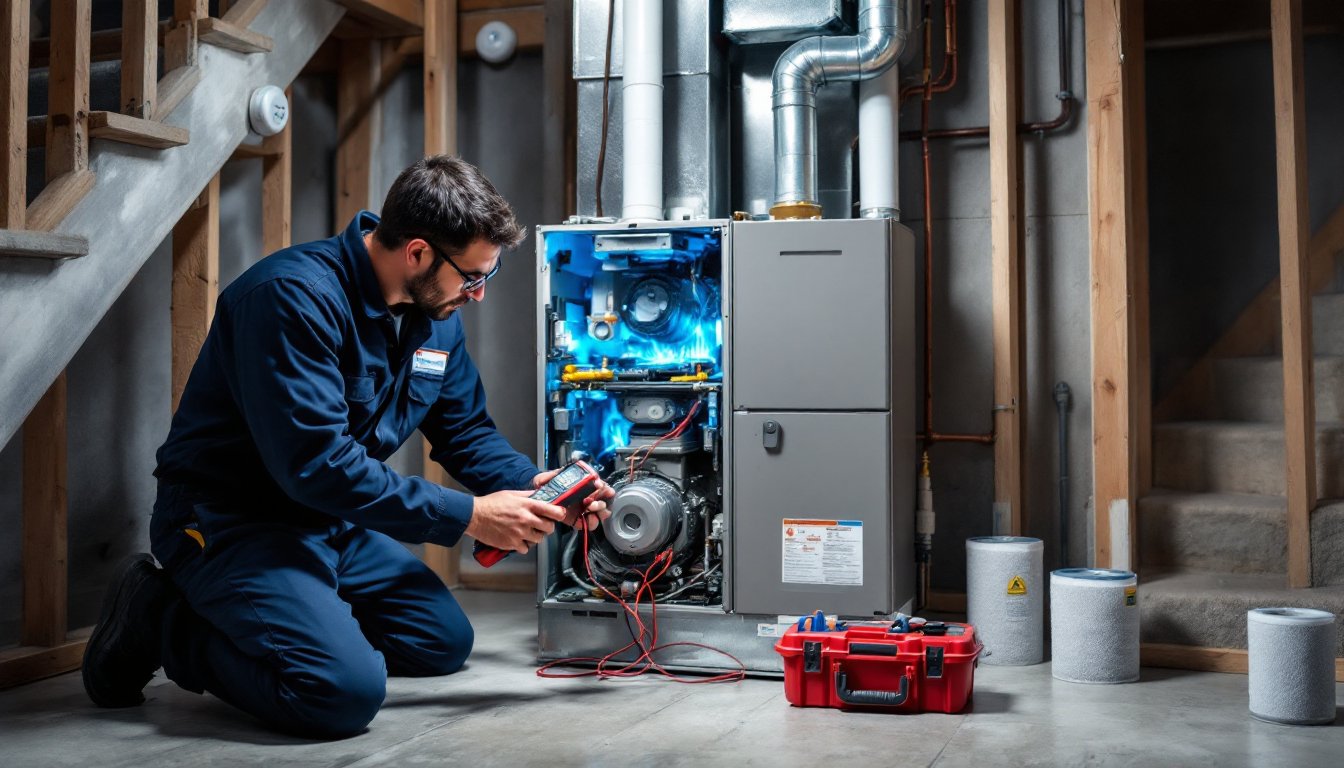
A thorough professional furnace inspection and tuneup typically takes 60 to 90 minutes and covers both safety and performance. Here’s what a qualified technician should do:
Combustion and Safety Checks:
- Inspect the heat exchanger for cracks or corrosion (the most critical safety check)
- Test gas pressure and adjust the burner flame for proper combustion
- Check the flue and venting system for blockages or improper drafting
- Measure carbon monoxide levels in the exhaust and around the unit
- Verify that the flame sensor is clean and responding correctly
Mechanical and Electrical Components:
- Inspect and tighten all electrical connections
- Test the blower motor and capacitor: measure amp draw
- Lubricate motor bearings if the unit has oil ports (many modern sealed motors don’t require this)
- Check the condition of the blower wheel and clean if needed
- Inspect the igniter (hot surface ignition systems) or pilot assembly (older standing-pilot furnaces)
- Test the limit switch and rollout switches for proper operation
Airflow and Efficiency:
- Inspect or replace the air filter
- Check all ductwork connections near the furnace for leaks
- Measure temperature rise across the heat exchanger to verify it’s within manufacturer specs (typically 40–70°F)
- Test the thermostat for accurate calibration and proper cycling
A good technician will also explain findings and give recommendations. When searching for reliable service providers, contractor reviews and cost comparisons can help identify qualified HVAC professionals in the Chicago area. If they find issues, ask questions. Understand what’s urgent (a cracked heat exchanger requires immediate shutdown), what’s preventive (a capacitor testing weak but still functional), and what’s optional (duct sealing is a good idea but not an emergency).
DIY Furnace Maintenance Tasks Chicago Homeowners Can Handle
Homeowners can, and should, perform basic maintenance tasks between professional visits. These don’t require specialized tools or technical knowledge, but they make a real difference in system performance and longevity.
Monthly Filter Checks and Replacements
The furnace filter is the single most important maintenance item a homeowner controls. A clogged filter restricts airflow, forcing the blower motor to work harder and reducing heat output. In extreme cases, restricted airflow can cause the furnace to overheat and shut down on the limit switch.
Standard 1-inch fiberglass filters should be checked monthly and replaced when visibly dirty, often every 30 to 60 days during heavy use. Hold the filter up to a light: if you can’t see through it clearly, it’s time for a new one.
Pleated filters (MERV 8 to MERV 11) capture more dust and allergens but also restrict airflow more. These typically need replacement every 60 to 90 days, though homes with pets or high dust levels may need more frequent changes.
High-efficiency filters (MERV 13 and above) can significantly restrict airflow on furnaces not designed for them. Check your furnace manual before upgrading beyond MERV 11. If the blower motor wasn’t sized for high-resistance filters, you’ll create more problems than you solve.
Filters are directional. Look for the arrow printed on the frame, it shows airflow direction. The arrow should point toward the furnace, away from the return duct. Installing a filter backward reduces its effectiveness.
Filters are sold by nominal size (16x20x1, 20x25x1, etc.), but actual dimensions are typically 0.25 to 0.5 inches smaller to allow the filter to slide into the track. Measure your filter slot if you’re unsure of the size.
Thermostat Testing and Calibration
A thermostat that reads inaccurately wastes energy and creates comfort problems. Test yours a couple times during the heating season.
Place a reliable thermometer on the wall next to the thermostat. Wait 15 minutes, then compare readings. If they differ by more than 2°F, the thermostat may need calibration or replacement.
For mechanical thermostats with a calibration screw (usually behind the faceplate), small adjustments can bring the reading back in line. Digital thermostats typically don’t have user-accessible calibration, but many have a temperature offset setting in the menu.
Also check the thermostat’s location. If it’s in direct sunlight, near a heat source, or in a drafty hallway, it won’t accurately reflect the home’s overall temperature. Relocating a thermostat is a straightforward wiring job, but it does require running low-voltage wire through walls.
For older homes, regular maintenance task checklists help homeowners stay on top of seasonal upkeep beyond just furnace care.
Other Simple DIY Tasks:
- Keep the area around the furnace clear. Code requires 30 inches of clearance on the service side for safe access.
- Vacuum dust from floor registers and return grilles monthly.
- Listen for unusual sounds, squealing, banging, or rumbling, that signal mechanical problems.
- Check that the condensate drain (on high-efficiency furnaces) isn’t clogged. A blocked drain will shut the furnace down.
Signs Your Chicago Furnace Needs Immediate Attention
Some problems can wait for a scheduled service call. Others demand immediate action. Here’s when to pick up the phone, or shut down the system.
Shut Down the Furnace Immediately If:
- You smell natural gas (a sulfur or rotten-egg odor). Evacuate, don’t touch electrical switches or create sparks, and call the gas company emergency line from outside.
- You see yellow or flickering flames instead of steady blue. This indicates incomplete combustion and possible carbon monoxide production.
- The carbon monoxide detector goes off. Get everyone outside and call 911.
- You see cracks or rust holes in the heat exchanger (visible through the burner compartment). A cracked heat exchanger can leak CO into your home’s air.
Call for Service Within 24 Hours If:
- The furnace is short-cycling, turning on and off every few minutes. This usually indicates a failing component, restricted airflow, or a malfunctioning thermostat.
- You hear loud banging or booming at startup. This can be caused by delayed ignition, which allows gas to build up before igniting.
- The blower runs constantly and won’t shut off.
- Heating is uneven, some rooms are cold while others overheat, and adjusting registers doesn’t help.
- Utility bills spike without explanation. A sudden 25% increase suggests the furnace is losing efficiency fast.
Schedule Service Soon If:
- The furnace makes new or worsening noises: squealing (belt or bearing issue), rumbling (burner problem), or rattling (loose panel or ductwork).
- Airflow from registers seems weaker than normal.
- The furnace struggles to maintain temperature on cold days, running continuously without reaching the setpoint.
- You notice increased dust or soot around registers.
Chicago’s cold doesn’t wait. When estimating repair costs or evaluating whether it’s worth fixing an older unit, project cost guides and contractor matching services provide helpful benchmarks for common furnace repairs and replacements.
If your furnace is 15 years or older and facing a major repair (heat exchanger, blower motor, or gas valve), it’s often smarter to replace the unit rather than sink money into an aging system. Modern furnaces are significantly more efficient, 95% AFUE or higher compared to 60–80% for older units, and the energy savings can offset replacement costs over time.